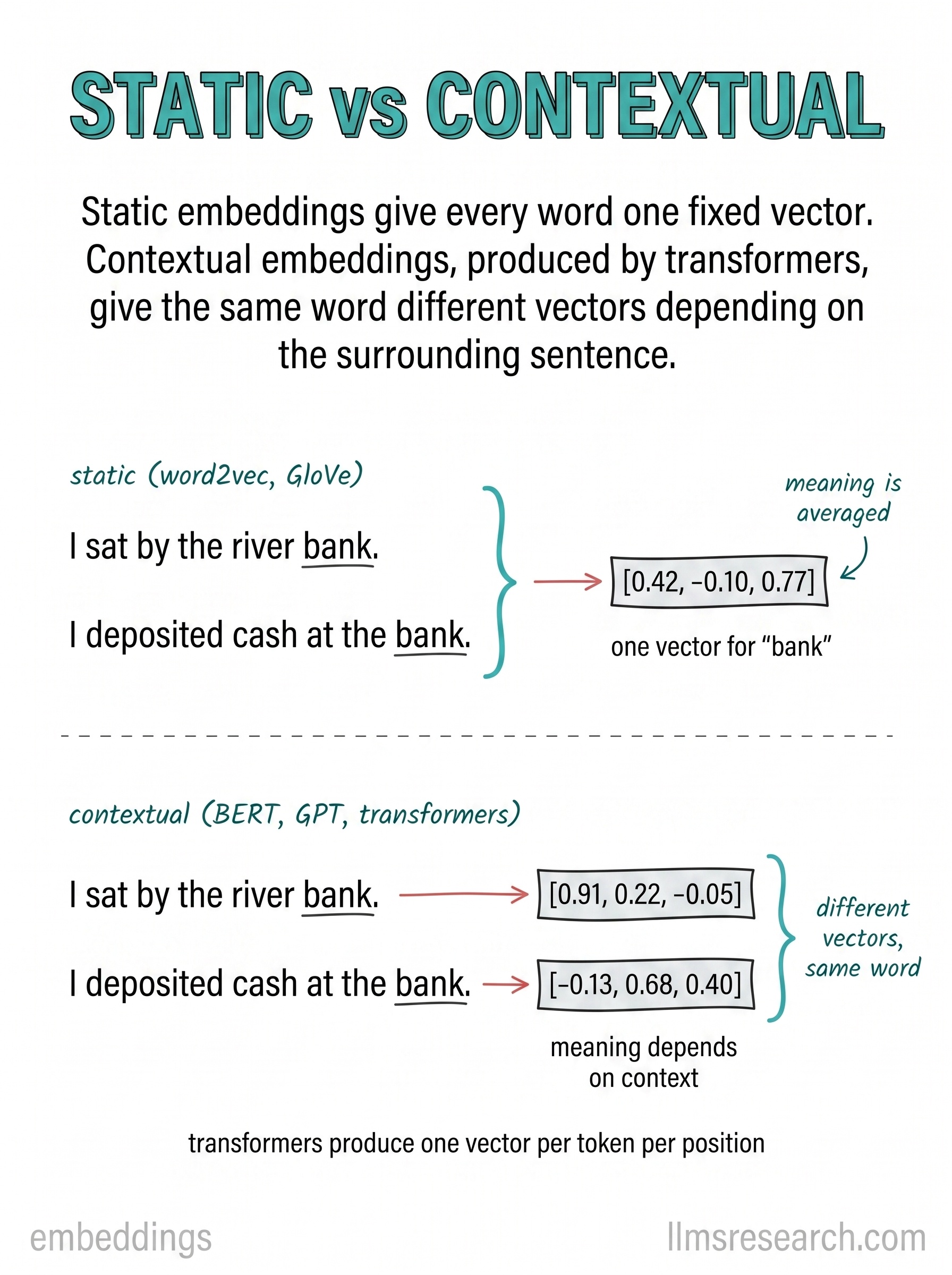
Everything so far quietly assumed a word has one vector. That is true for the first generation of embeddings and false for the models this course is really about. The card draws the split.
The top half is static embeddings, the word2vec and GloVe era. Each word gets one fixed vector, decided during training and then frozen. The trouble is words with more than one sense. The card uses “bank”: the river bank and the money bank both map to the same vector, so the two meanings are averaged into one blurry point. The representation cannot tell them apart, because it was built before the sentence was known.
The bottom half is contextual embeddings, produced by transformers like BERT and GPT. Here the vector for a word is computed after reading the sentence, so “bank” in “I sat by the river bank” gets a different vector from “bank” in “I deposited cash at the bank”. Same word, different vectors, because the surrounding words shaped each one. The representation is no longer a fixed property of the word but an output that depends on context.
That shift is the hinge of the whole field. Once a model can assign meaning per occurrence rather than per word, it can handle ambiguity, track what a pronoun refers to, and let a word’s sense bend to its sentence. The line at the bottom states the mechanism plainly: transformers produce one vector per token per position. Every token comes out carrying not just its own identity but a reading of where it sits.
The natural question is how the sentence gets mixed into each vector. That is exactly what attention does, and it is where the next part of the course begins.