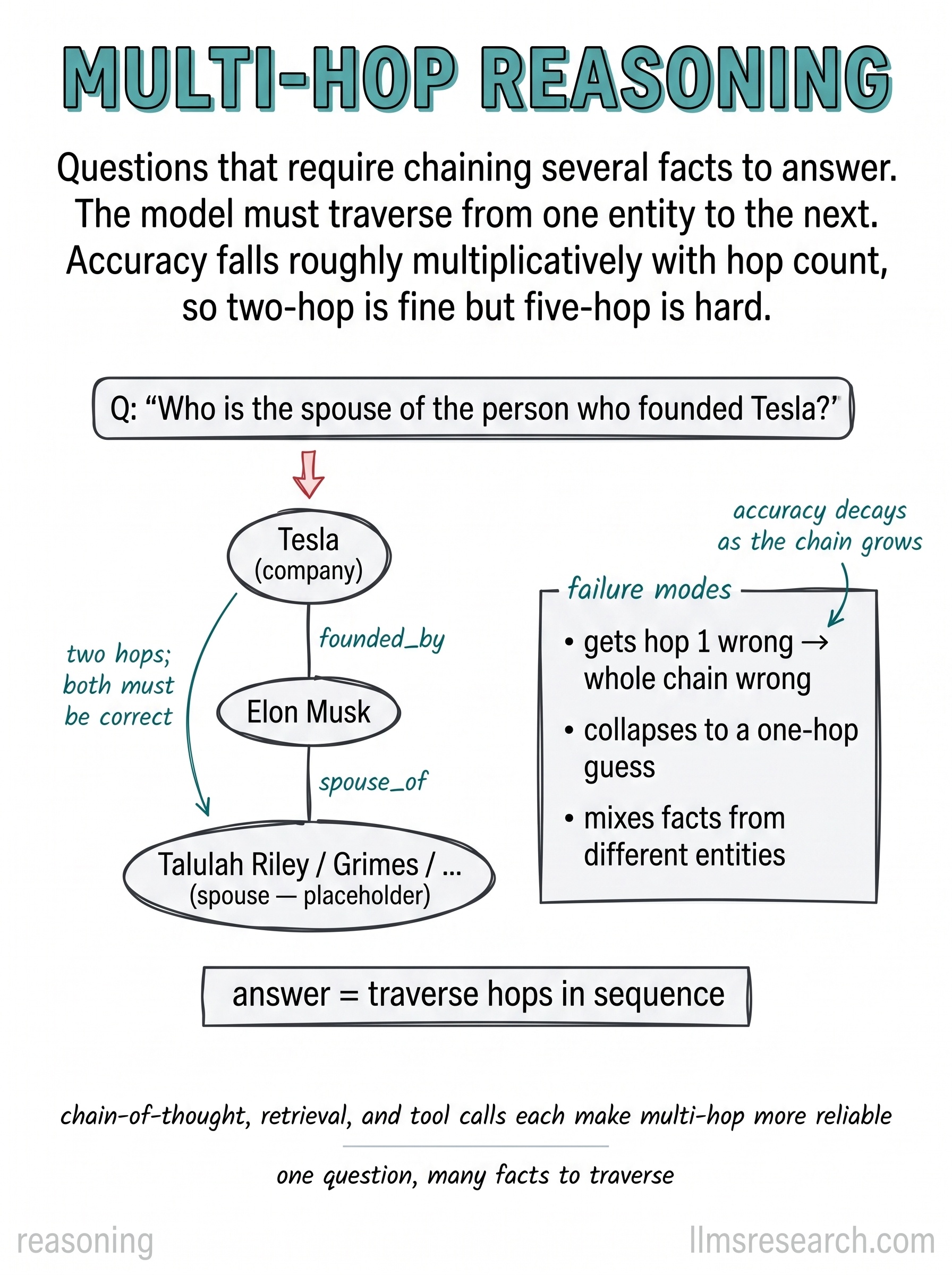
The card draws a small graph for one question: who is the spouse of the founder of SpaceX? Nodes label SpaceX, Elon Musk, and a spouse name. Edges carry relation labels such as founded_by and spouse_of. A path from company to person to person shows two hops both must be correct. A failure box lists typical mistakes: wrong first hop, collapsed one-hop guess, mixed entities.
Each hop is a conditional probability. If the model is ninety percent reliable per step, two hops land near eighty-one percent and five hops fall well below that without support. That is why multi-hop QA stress-tests both knowledge and procedure. The model must identify which fact to fetch first, which entity to pivot through, and when to stop.
Chain-of-thought makes hops visible so you can see where a chain breaks. Retrieval injects the missing edge when weights alone are stale or sparse. Tool calls can query a knowledge graph or search API per hop instead of guessing from parametric memory. ReAct-style loops alternate thought, action, and observation until the graph is complete.
Design benchmarks with explicit hop count and entity types your product actually needs. Short chains may work with a single prompt; longer chains benefit from structured plans or external memory. The card caption compresses the requirement: one question, many facts to traverse, which is the signature of compositional reasoning rather than lookup.