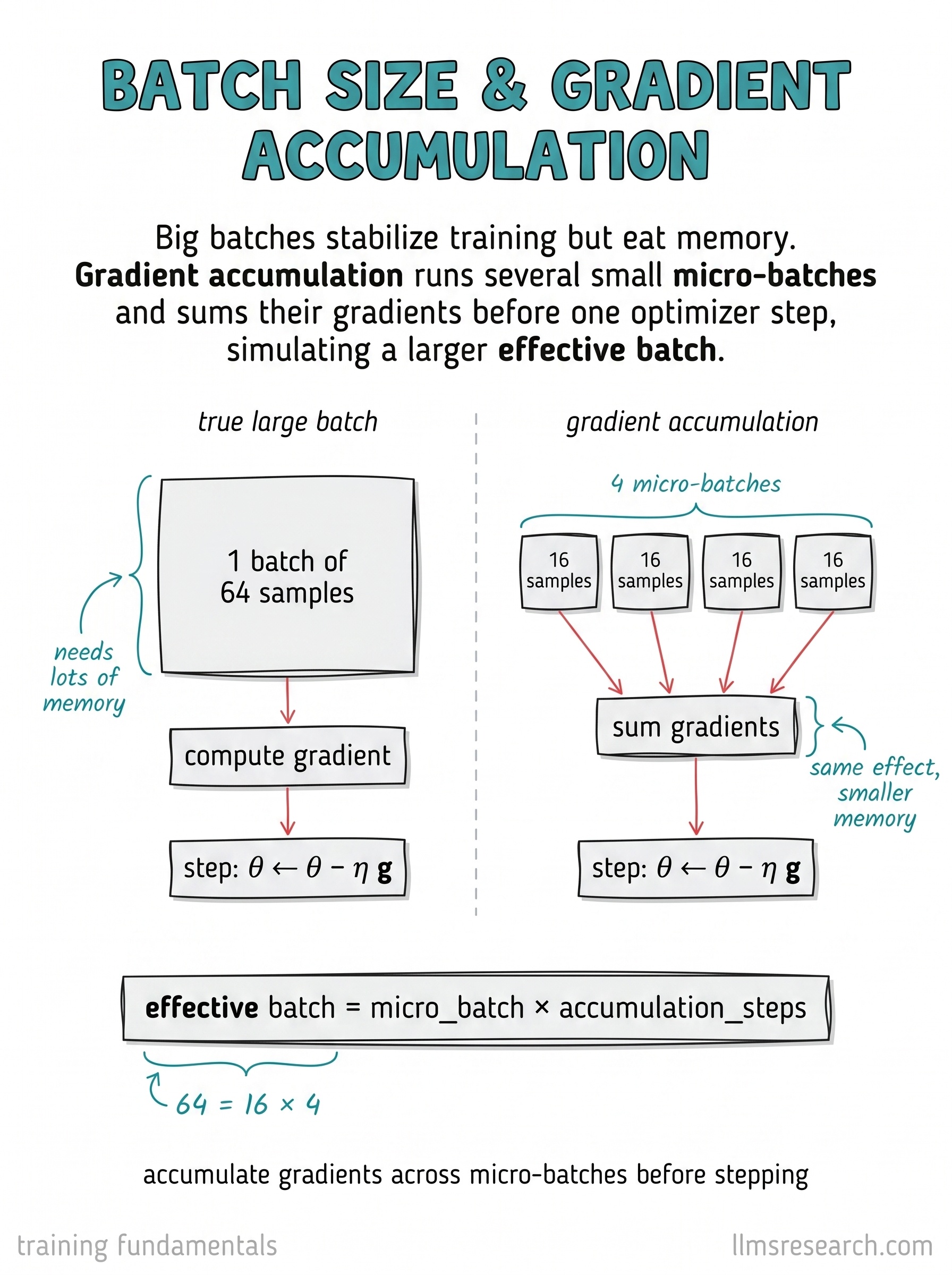
Each optimizer step is computed from a batch of examples, and the size of that batch matters. A larger batch averages the gradient over more samples, so the direction it points is less noisy and the training is steadier. The catch is memory. Every example in the batch has to hold its activations for the backward pass at once, so doubling the batch roughly doubles the memory the forward and backward passes need, and hardware runs out well before the batch is as large as you might want.
Gradient accumulation gets the stabilizing effect without the memory bill. The card contrasts the two routes to the same result. On the left, a true batch of 64 samples goes through the model together, produces one gradient, and takes one step. On the right, the 64 are split into four micro-batches of 16. Each micro-batch runs its own forward and backward pass, its gradient is added to a running sum, and only after all four have contributed does the optimizer take a single step using the summed gradient.
The reason this works is that the gradient of a sum is the sum of the gradients. Processing four micro-batches and adding their gradients gives the same total as processing all 64 together, so the update is mathematically the batch-of-64 update. What changes is peak memory: only 16 examples’ activations exist at any moment, since each micro-batch is freed before the next begins. The bottom line states the bookkeeping, effective batch equals micro-batch size times the number of accumulation steps, 64 equals 16 times 4.
Two details keep the equivalence exact. The gradients must be averaged consistently with how the loss is normalized, otherwise the accumulated step is scaled wrong and effectively changes the learning rate. And the optimizer step, along with any gradient clipping, happens once per effective batch, not once per micro-batch, so the clip threshold from the next card applies to the full summed gradient. Accumulation trades time for memory: four sequential passes are slower than one big parallel pass, which is why it is a lever for fitting large effective batches on limited hardware rather than a free improvement.