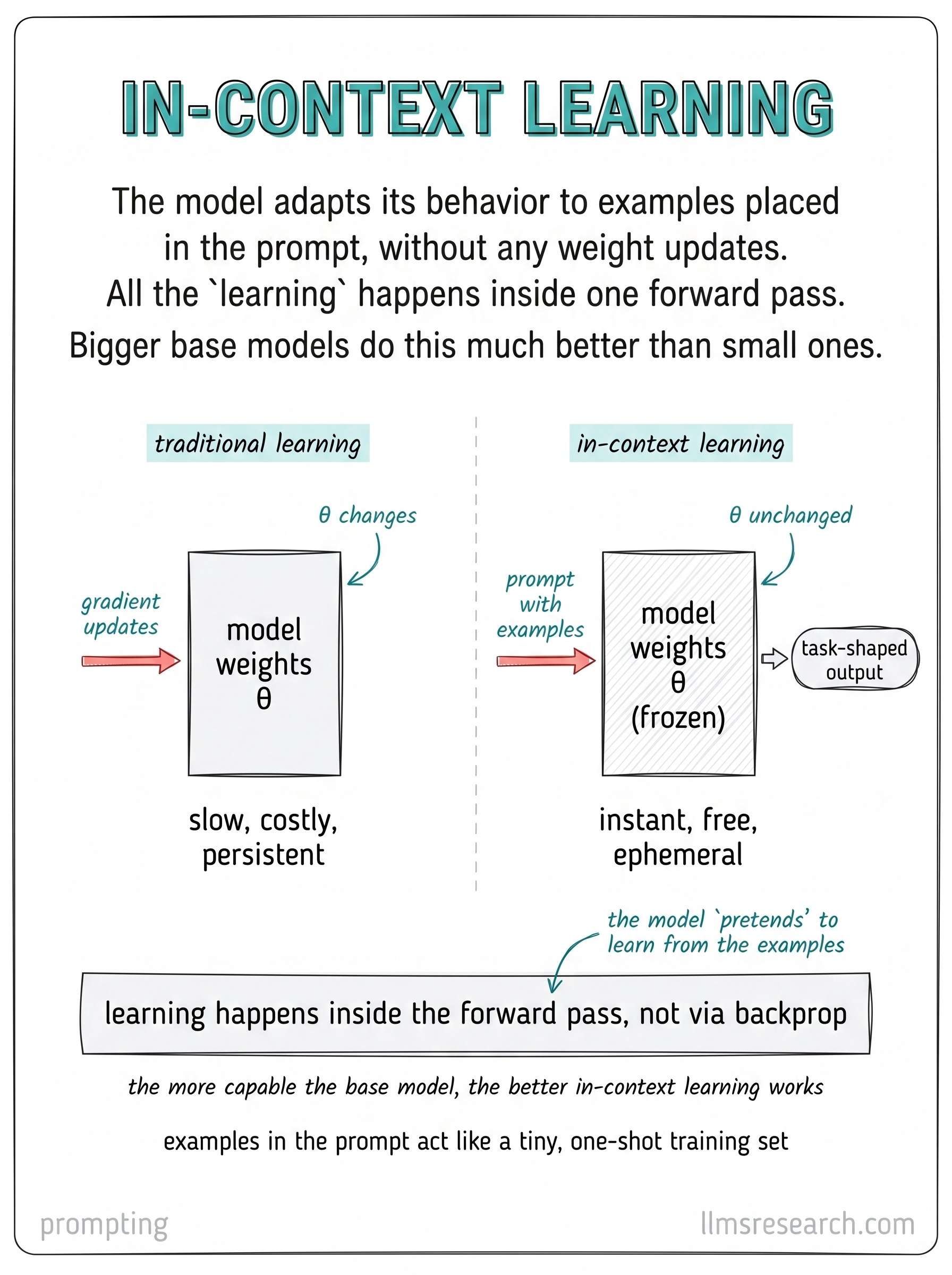
The card splits the diagram in two. On the left, traditional learning: a training loop sends gradients back into the weights and permanently changes parameters. On the right, in-context learning: examples sit in the prompt, the forward pass runs once, and the weights stay fixed while behavior shifts for that request. The contrast is the whole idea: learning without an optimizer step.
Mechanically, the model treats prompt tokens like any other context. Attention layers relate the new task token to demonstration tokens, and the next-token distribution shifts toward patterns that fit the demonstrated mapping. This is why a handful of labeled pairs can steer classification, extraction, or style on the fly. It is also why the effect is fragile: remove the examples and the behavior reverts, change their order or labels and performance can swing.
In-context learning explains why prompting feels like teaching in the moment and why it is not a substitute for fine-tuning when you need stable, high-volume behavior. ICL is fast to iterate, requires no GPU training job, and works well for format and style transfer. Fine-tuning bakes knowledge and habits into weights, survives absent prompts, and scales better when every token of context counts. Most production systems combine both: tuned weights for baseline competence, few-shot or instruction text for task-specific edges.
The practical takeaway is to see the prompt as a temporary task specification. You are not updating the model; you are supplying additional evidence the architecture already knows how to use. That framing clarifies limits as well as strengths. ICL cannot add facts the model never saw reliably, and it competes with history, retrieval, and system instructions for the same window. Use it where flexibility matters; use training where persistence matters.