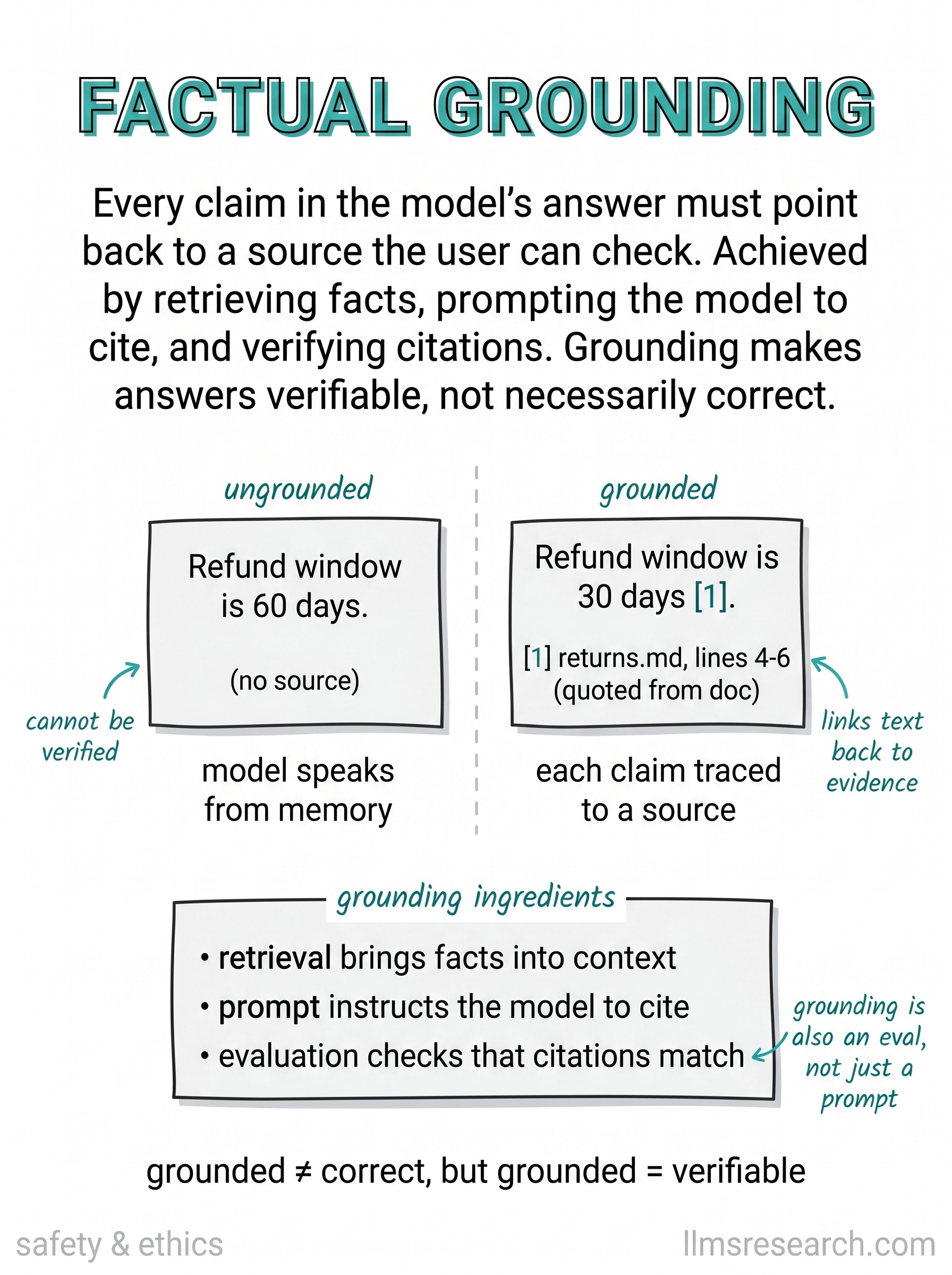
Hallucination is fluent text without truth. Factual grounding is the structural fix: tie each claim to evidence a user can inspect. The card contrasts two answers to the same policy question. The ungrounded side states a refund window from memory with no source attached. The grounded side gives a number with a citation marker, links to a document and line range, and quotes the supporting text. One answer can be checked; the other cannot.
Grounding is a system property, not a single prompt trick. The ingredients list names three parts. Retrieval brings relevant documents into context so the model is not writing only from weights. The prompt instructs the model to cite what it uses. An evaluation step checks that citations actually support the claims. That last step matters because models can emit citation-shaped text that points nowhere useful.
The mechanism does not guarantee correctness. A grounded answer can still cite the wrong passage or misread a table. What grounding buys is verifiability. A user or downstream checker can open the source and see whether the claim holds. The card’s caption states the distinction plainly: grounded does not mean correct, but grounded means verifiable.
In product terms, grounding is how you reduce uncheckable assertions in domains where errors carry cost: support bots, legal summaries, medical information, internal policy lookup. It pairs naturally with retrieval pipelines and with eval suites that score citation precision and recall. The takeaway is to design for traceable claims when facts matter, and to treat grounding quality as something you measure, not something you assume from prompt wording alone.