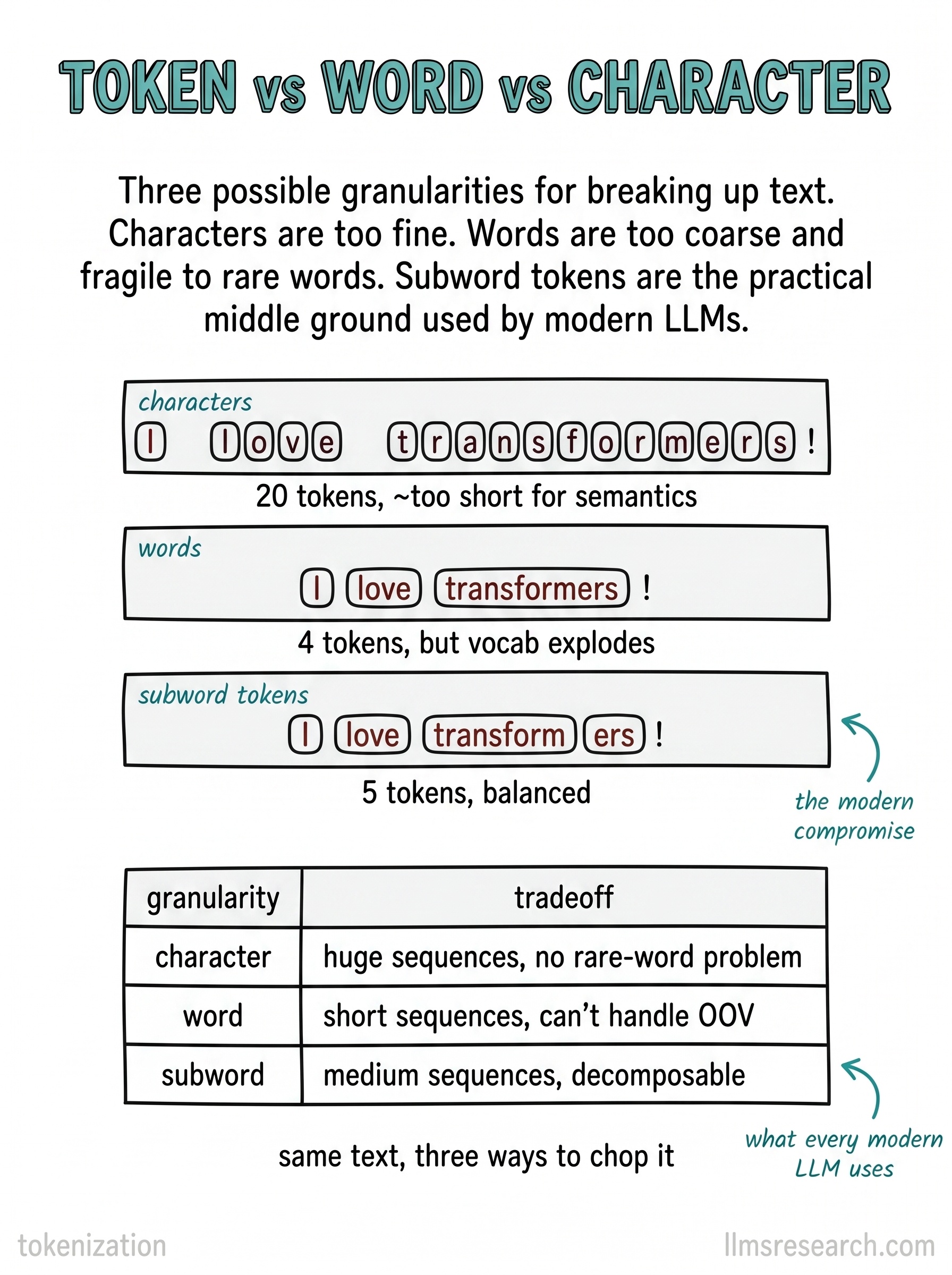
There are only three real choices for how finely to cut text, and the card shows all three on the same sentence. “I love transformers!” becomes twenty character tokens, or four word tokens, or five subword tokens. The differences between those numbers are the whole argument.
Characters are the safe option that nobody uses alone. The alphabet is tiny, so the vocabulary never fails to represent anything, but a single character carries almost no meaning and the sequence gets long fast. Since attention cost grows with sequence length, spelling everything out one letter at a time is expensive for very little semantic payoff.
Words look natural to us and are the worst fit for a model. The vocabulary would have to contain every word the model might ever see, which is impossible: names, typos, compounds, and words coined after training all fall outside it. The card labels this the out-of-vocabulary problem, and there is no graceful recovery. The first unfamiliar word has no ID at all.
Subwords resolve the tension rather than splitting the difference arbitrarily. Frequent words stay whole, so common text is compact, while rare words fall back to smaller known pieces, so nothing is ever unrepresentable. The sequence lands at a medium length, and the vocabulary stays a fixed, manageable size. That combination, short enough to be efficient and complete enough to never break, is why every modern model lands here.
The comparison is worth keeping in mind because the granularity is not just an implementation detail. It sets the sequence length the model pays for, decides what counts as a single unit of meaning, and quietly shapes which tasks are easy and which are awkward. The specific algorithm that finds a good subword vocabulary is the next card.