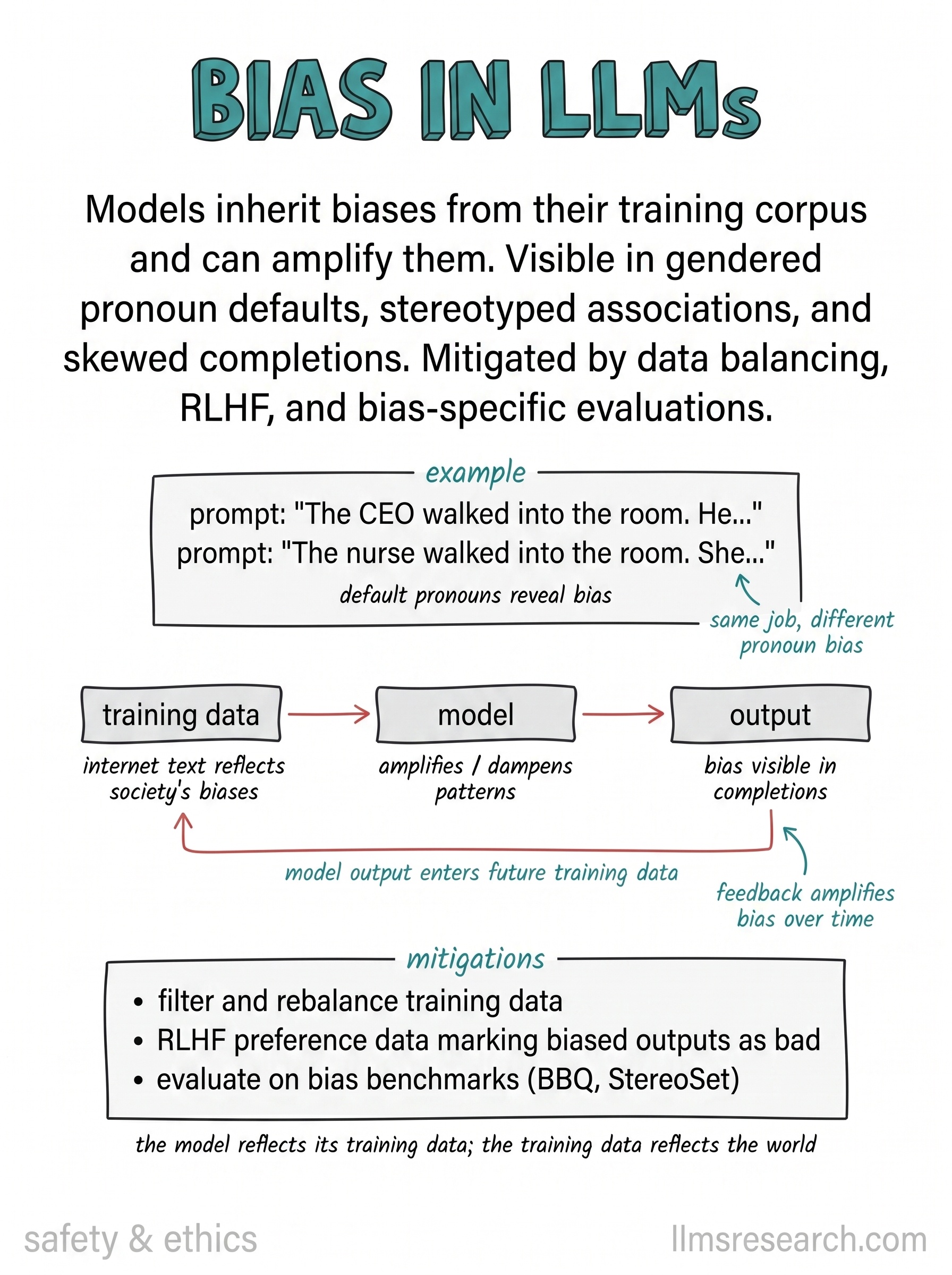
Bias in language models is not a single bug with a single fix. The card opens with a small completion test. Given CEO walked into the room, the model continues with He. Given nurse walked into the room, it continues with She. The job titles are neutral; the pronoun defaults are not. Same structure, different demographic skew, which is how bias often appears in practice: not as an explicit rule, but as a statistical tilt in otherwise ordinary text.
The pipeline below traces where that tilt enters. Training data reflects societal patterns in web text. The model learns those patterns and may amplify or dampen them depending on architecture and training dynamics. The biased output then feeds future corpora if scraped back into training, which closes a feedback loop the card labels as bias amplification over time.
Mitigation spans data, tuning, and measurement. Filter and rebalance training data where feasible. Use RLHF preference labels that mark stereotyped completions as undesirable. Run bias benchmarks such as BBQ and StereoSet to track regressions across model versions. None of these steps removes bias entirely, but they make skew visible and give teams a lever when releases must meet policy thresholds.
The caption states the root cause without drama: the model reflects its training data, and the training data reflects the world. That is why bias evaluation belongs alongside capability benchmarks. A model can score well on MMLU while still defaulting to skewed pronouns or stereotyped associations on open-ended prompts. Measure on targeted probes, document known failure modes, and treat bias reduction as an ongoing process tied to data choices and preference data, not a one-time filter.