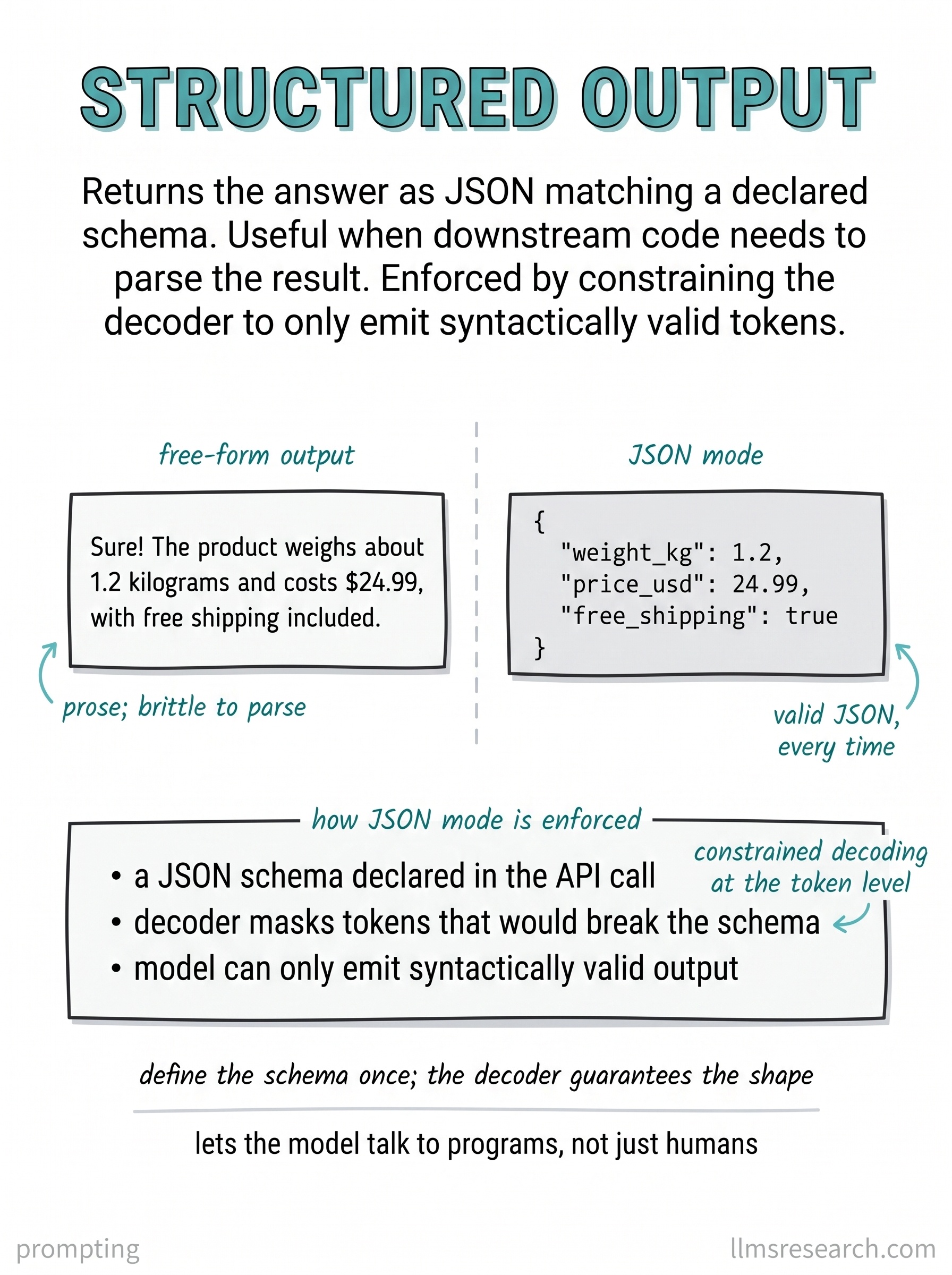
The card contrasts two outputs for the same extraction task. On the left, the model answers in conversational prose with numbers and booleans embedded in sentences, which is readable but brittle to parse with regex. On the right, the model returns a compact JSON object with typed fields. Below both halves, a mechanism box lists how providers enforce structure: JSON mode, declared schemas, and constrained decoding that blocks tokens which would break the schema.
JSON mode typically guarantees valid JSON syntax: braces balance, strings quote correctly, trailing commas are suppressed. That alone removes a large class of integration bugs. Structured output goes further when the API accepts a schema and applies logit masking or grammar guidance so required keys appear and enum fields stay in range. Not every endpoint offers full schema enforcement; some only nudge format through prompting plus JSON mode.
Use structured output anywhere downstream code consumes model results: tool arguments, form filling, agent plans, evaluation pipelines. Keep schemas small and name fields clearly in the prompt even when the API enforces shape. Reserve temperature near zero for deterministic fields. Validate on your side anyway; syntax validity does not guarantee semantic correctness, and null or empty strings can still slip through valid JSON.
The card’s caption states the integration goal: let the model talk to programs, not only humans. Free text is fine for chat; contracts between services need parseable types. When schema support is weak, combine JSON mode with delimiters and a strict system instruction, then run a repair pass or retry on validation failure. Treat provider capabilities as part of the design checklist, not an afterthought.