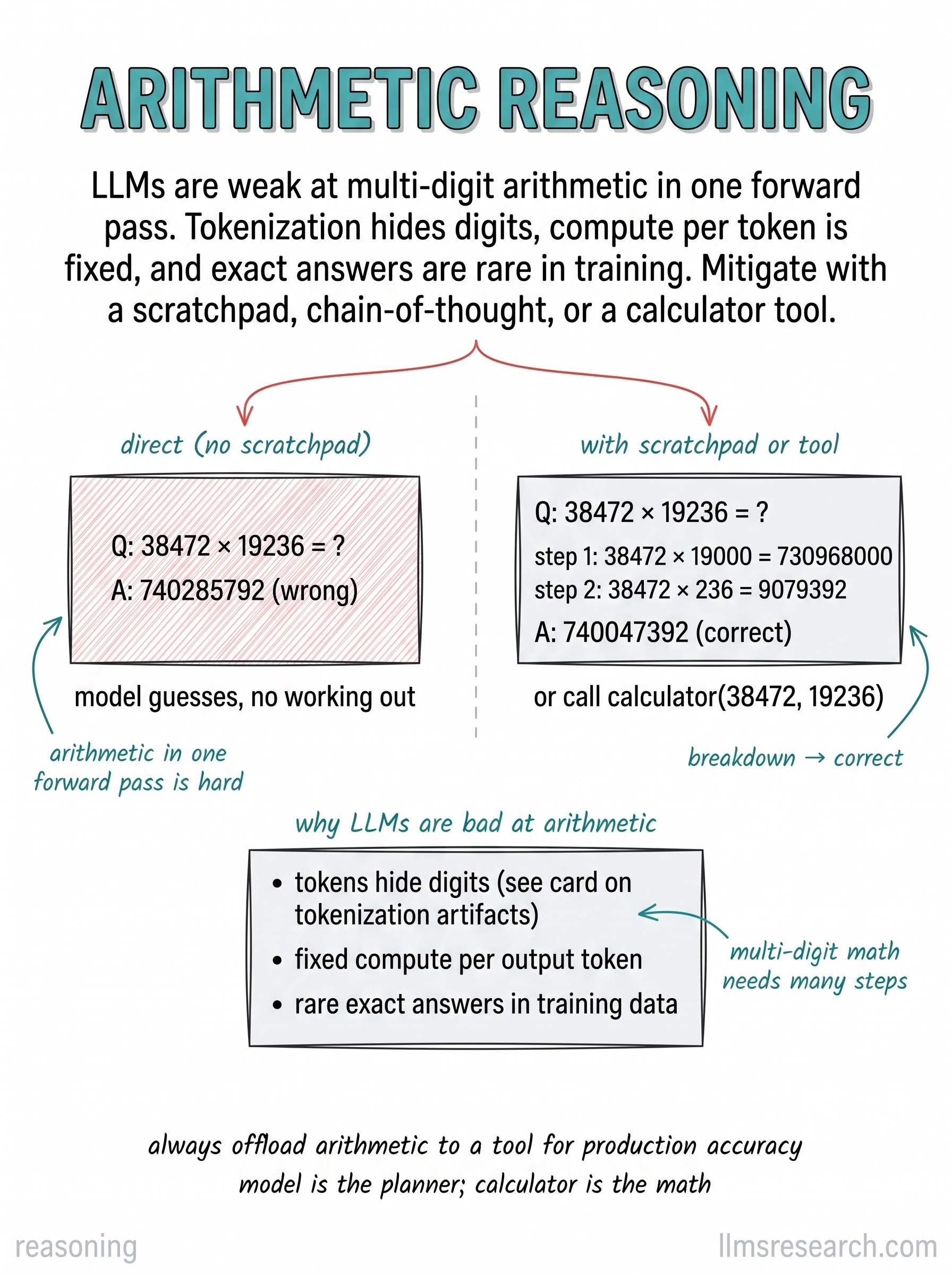
The card compares two approaches to the same five-digit multiplication. On the left, the model answers in one line and gives a wrong product, as if the calculation happened internally without written steps. On the right, the model either writes partial products in a scratchpad or calls a calculator tool and returns the exact result. The visual argument is specific: exact arithmetic is a weak point for pure latent computation.
Transformers predict likely tokens, not symbolic rules. They can approximate common patterns seen in training but drift on long carries, uneven operands, or nested operations. Chain-of-thought and scratchpads help by externalizing partial results so each step conditions the next. Even then, manual long division in text can still slip. Tools and code execution remove the burden from the language model entirely for the numeric kernel.
For applications that need guaranteed correctness, treat the LLM as planner and narrator, not as CPU. Parse numbers from the problem, pass them to a calculator or Python runtime, and let the model explain the result. When tools are unavailable, require explicit step format, validate with a independent recomputation on your side, and retry on mismatch.
Arithmetic benchmarks are useful sanity checks when choosing a reasoning strategy. Gains from CoT show up clearly here; gains from bigger context windows do not. The card’s takeaway is task fit: match the mechanism to the error mode. If the failure is silent miscalculation, more prose alone may not suffice; give the model a scratchpad and, when possible, a real executor.